
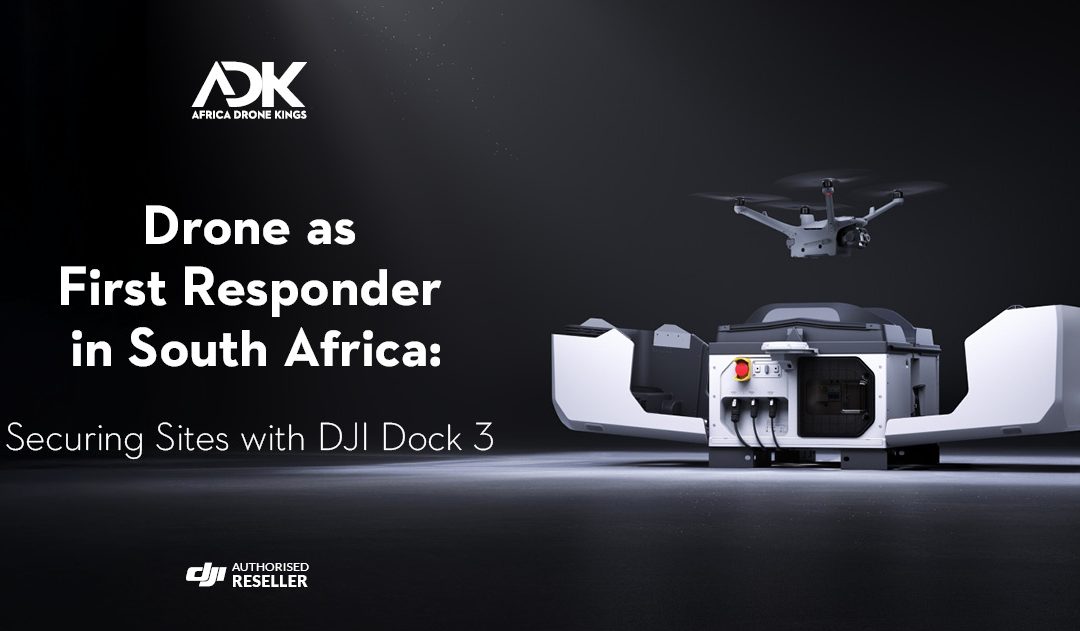
How DJI Dock 3 Enables Rapid Aerial First Response for Security and Critical Infrastructure
Security in South Africa operates under unique pressure.
According to perception-based crime indices, South Africa has a crime index score of approximately 74.5 out of 100 in 2026 – one of the highest crime perception scores globally as rated by citizens and organisations. For residential estates, game farms, mining operations and industrial facilities, this isn’t just a statistic – it’s a daily operational reality.
Add to this the scale of many South African properties – expansive estates, remote conservation areas, critical infrastructure sites and large industrial footprints – and one challenge becomes clear: response time.
When an alarm is triggered, the minutes that follow can determine the outcome. Traditional response models rely on ground teams navigating traffic, terrain or access constraints before verifying what’s actually happening.
This gap between alarm activation and verified situational awareness is where Drone as First Responder (DFR) technology changes the equation.
With a DJI Dock 3 Security station installed on site, organisations can automate aerial response. When an alarm or sensor is triggered, a drone launches from the dock, flies to the area of interest and streams real-time video to operators often within seconds. The drone itself is sold separately and integrates with the Dock 3 station to create a complete autonomous aerial monitoring solution.
This isn’t about replacing response teams. It’s about equipping them with faster visibility, better intelligence and informed decision-making before personnel arrive on scene.
In a country where security and rapid situational awareness are ongoing operational demands, that capability matters.

What Is Drone as First Responder with DJI Dock 3?
Drone as First Responder (DFR) is an automated aerial system that launches immediately when an alarm, sensor trigger or emergency call is received.
At the centre of this system is the DJI Dock 3 – a rugged, weather-resistant docking station that houses, charges, protects and deploys a compatible DJI drone. The dock can be permanently installed on a building, within a secure compound, or mounted on a vehicle depending on operational requirements.
When integrated with compatible DJI enterprise drones (sold separately), Dock 3 enables:
- Automated launch upon alarm activation
- Remote mission planning and dispatch
- Live HD video streaming to a control room
- Real-time situational awareness
- Autonomous return-to-dock charging and readiness
In addition to automated launch and return functionality, DJI Dock 3 supports visual and thermal payload integration (depending on drone configuration), enabling comprehensive aerial intelligence gathering during day or night operations.
Pre-configured FlyTo missions optimise flight paths for faster response to predefined zones, while operators can seamlessly assume manual control in developing situations that require human judgement.
For higher-risk environments, features such as Task Area Management allow operators to define controlled flight zones, reducing operational risk and supporting compliant deployments.
The DJI Dock 3 is the enabling infrastructure. The drone is a separate component that integrates into the dock to create a complete DFR solution. Together, they transform static security infrastructure into an intelligent, responsive aerial system.

Compatible Drones: Matrice 4D and Matrice 4TD
DJI Dock 3 is designed to work seamlessly with the all-new DJI Matrice 4D (M4D) and Matrice 4TD (M4TD) enterprise drones, purpose-built for autonomous dock operations.
The Matrice 4D is equipped with advanced visual imaging capabilities, making it ideal for high-resolution daylight surveillance, perimeter monitoring and detailed incident assessment.
The Matrice 4TD adds an integrated thermal camera alongside visual sensors, enabling night-time operations, low-visibility response and heat-signature detection – a critical advantage for security, infrastructure protection and emergency services.
Both platforms are water and dust resistant, engineered for harsh environments and extended operational use. When paired with DJI Dock 3, they deliver a fully autonomous aerial response capability with enhanced situational awareness across day and night conditions.

Rapid Alarm Verification: Closing the Response Gap
False alarms are costly. Delayed verification is risky.
In residential estates, business parks and commercial properties, security teams often respond to alarm triggers without knowing whether the threat is genuine. Ground response vehicles must navigate traffic or internal road networks before confirming what’s actually happened.
With DFR enabled by DJI Dock 3, an aerial unit can deploy within seconds.
When equipped with the Matrice 4TD’s thermal payload, operators can verify incidents even in darkness, fog or dense vegetation – identifying heat signatures that would otherwise remain hidden. In high-risk environments, this capability significantly improves decision-making before ground teams are dispatched.
Instead of dispatching personnel blindly, control rooms can:
- Visually confirm perimeter breaches
- Identify suspicious vehicles
- Determine whether an intrusion is real or accidental
- Direct ground teams more efficiently
This reduces unnecessary dispatches, lowers fuel costs and improves response prioritisation.
As this technology moves from concept to deployment, services like AeroGuard are beginning to bring Drone as First Responder capabilities into real-world environments. AeroGuard is a managed aerial security solution built around DJI Dock 3, designed to provide rapid, automated drone response for estates, resorts, and large properties. Its first installation is currently underway at Sun City in South Africa’s North West province, demonstrating how autonomous aerial security can be integrated into existing operations to enhance visibility, response times and overall site protection.

Large Properties and Game Farms: Covering Ground at Speed
South African game farms, private reserves, and large residential or agricultural estates can span thousands of hectares.
Traditional patrol methods – vehicles, horseback or foot patrols – are resource-intensive and time-consuming. In anti-poaching scenarios or perimeter breaches, delays can be critical.
A DJI Dock 3 installed at a central operations point allows a drone to launch autonomously and cover vast areas quickly, providing:
- Perimeter monitoring
- Fence inspections
- Suspicious activity verification
- Support for anti-poaching patrols
Deploying aerial oversight without sending personnel into potentially dangerous situations adds a significant layer of safety.
Beyond fixed-site installation, DJI Dock 3 is DJI’s first dock to support vehicle-mounted deployment, allowing security teams to bring autonomous aerial capability directly where it’s needed.
Optimised for mobile use, the dock’s structure, internal components and environmental systems have undergone vibration testing to ensure reliable operation while mounted on patrol vehicles or rapid response units. Horizontal calibration and cloud-based dock location calibration support accurate deployment from mobile platforms.
For large estates, game reserves or industrial sites, aerial response is no longer tied to a single location – it can move with patrol teams and extend coverage across wider terrain.
For operations requiring extended coverage or redundancy, DJI Dock 3 also supports dual-dock deployment on a single vehicle. This allows teams to operate multiple drones from one mobile platform, extending flight continuity or alternating payload configurations to maximise availability.

Protecting Critical Infrastructure
South Africa’s critical infrastructure, from power substations to water treatment facilities, pipelines, rail corridors and telecommunications towers, remains vulnerable to theft, vandalism and sabotage.
These sites are often remote, spread across large footprints and difficult to patrol consistently.
DFR with DJI Dock 3 provides persistent oversight. When motion sensors, thermal cameras or IoT systems detect irregularities, a drone can launch automatically to provide immediate visual confirmation.
Rather than waiting for inspection teams, operators gain rapid aerial intelligence, reducing downtime and limiting potential damage.
Using the Matrice 4TD’s thermal imaging, control rooms can detect overheating equipment, unauthorised human presence after hours, or suspicious activity along remote infrastructure corridors. The Matrice 4D, meanwhile, provides high-detail visual inspection capability for daytime verification and documentation.

An Asset in Mining and Industrial Operations
Mining sites and industrial complexes face a unique combination of challenges:
- Vast operational areas
- Hazardous environments
- High-value assets
- Strict safety requirements
Deploying a drone from a Dock 3 station enables:
- Rapid inspection of restricted zones
- Monitoring of tailings dams and perimeter areas
- Incident assessment before dispatching personnel
- Night-time monitoring and heat-signature detection using the Matrice 4TD’s integrated thermal camera
The Matrice 4D and 4TD platforms are specifically engineered for dock-based deployment, offering extended flight performance and reliable autonomous operation. Their rugged, weather-resistant design ensures consistent performance across harsh industrial and mining environments.

Aiding Smart City Development and Emergency Services
As municipalities invest in smart infrastructure, DFR systems can integrate into broader public safety networks.
In emergency scenarios – fires, traffic accidents or crowd incidents – a docked drone can launch immediately to provide a first visual assessment.
For emergency services, this enables:
- Faster scene evaluation
- Improved resource allocation
- Reduced risk to responders
- Enhanced interdepartmental coordination
The drone becomes an aerial extension of the control room.
With its compact installation footprint, DJI Dock 3 supports clustered deployment across urban environments. Multiple docks positioned strategically across a city, industrial zone or estate network can create overlapping coverage and reduce response times.
When equipped with compatible visual and thermal payloads, control rooms gain comprehensive aerial intelligence within seconds of an incident being reported.

The Operational and Financial Case for DFR
DFR systems represent a strategic investment, but their value becomes clear when measured against operational inefficiencies.
Key cost offsets include:
- Reduced unnecessary vehicle dispatches
- Lower fuel and patrol costs
- Decreased vehicle wear and tear
- Faster threat verification
- More efficient allocation of personnel
- Improved evidence collection and reporting
Over time, organisations shift from reactive response models to proactive, data-driven oversight. In high-risk environments, that shift can be transformative.

A Smarter Layer of Security Infrastructure with DJI Dock 3
Drone as First Responder technology isn’t about replacing guards, patrol vehicles or emergency responders.
It adds a smarter layer of infrastructure.
With DJI Dock 3 as the foundation – and compatible DJI drones integrated into the system – organisations gain a security asset that is:
- Always charged
- Always protected
- Always ready
- Deployable within seconds
In a South African context defined by scale, security pressures and response challenges, that readiness is more than convenience – it’s strategic advantage.