
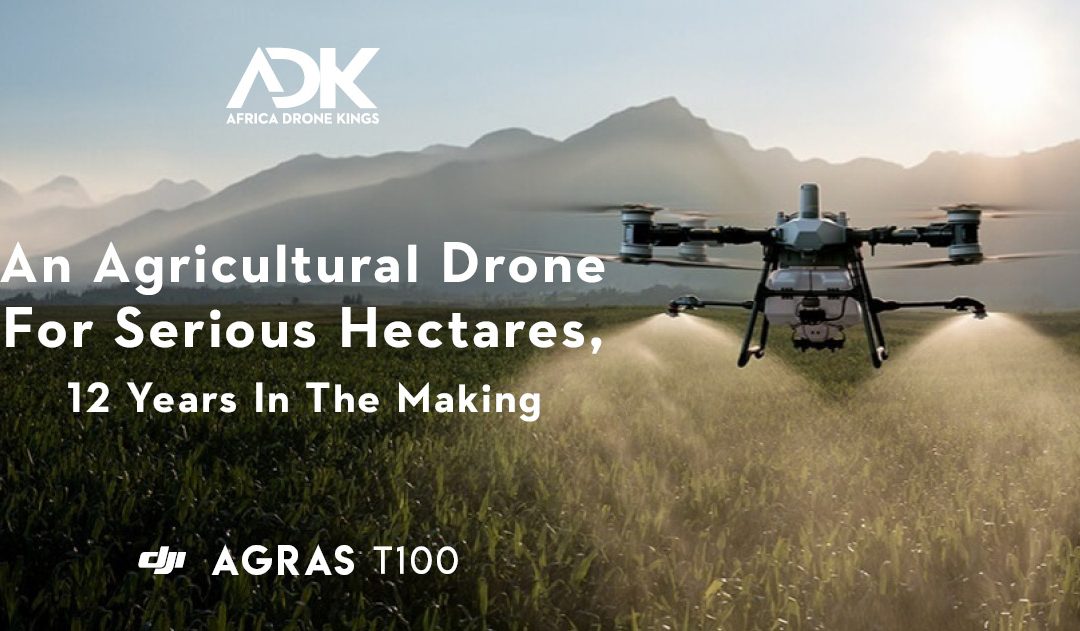
DJI Agras T100: A 100kg Payload Agricultural Drone for Large-Scale Farming Operations
Built for Scale, Heat and Distance: Why the DJI Agras T100 Drone Fits South African Agriculture
South African agriculture is defined by extremes.
Extreme scale. Extreme weather. Extreme distances. And increasingly, extreme pressure to do more with less.
From the maize belts of the Free State to citrus orchards in Limpopo, sugarcane fields along the coast, and vineyards in the Western Cape, local producers are operating in conditions that demand resilience, efficiency, and precision. Very few machines are truly built for this environment.
That’s where the DJI Agras T100 starts to separate itself from the noise.
Engineered for commercial farming, agricultural contractors, and producers managing serious hectares and designed over 12 years of agricultural drone development, it brings together payload capacity, safety, and multi-application flexibility at a scale that finally matches South African farming realities.
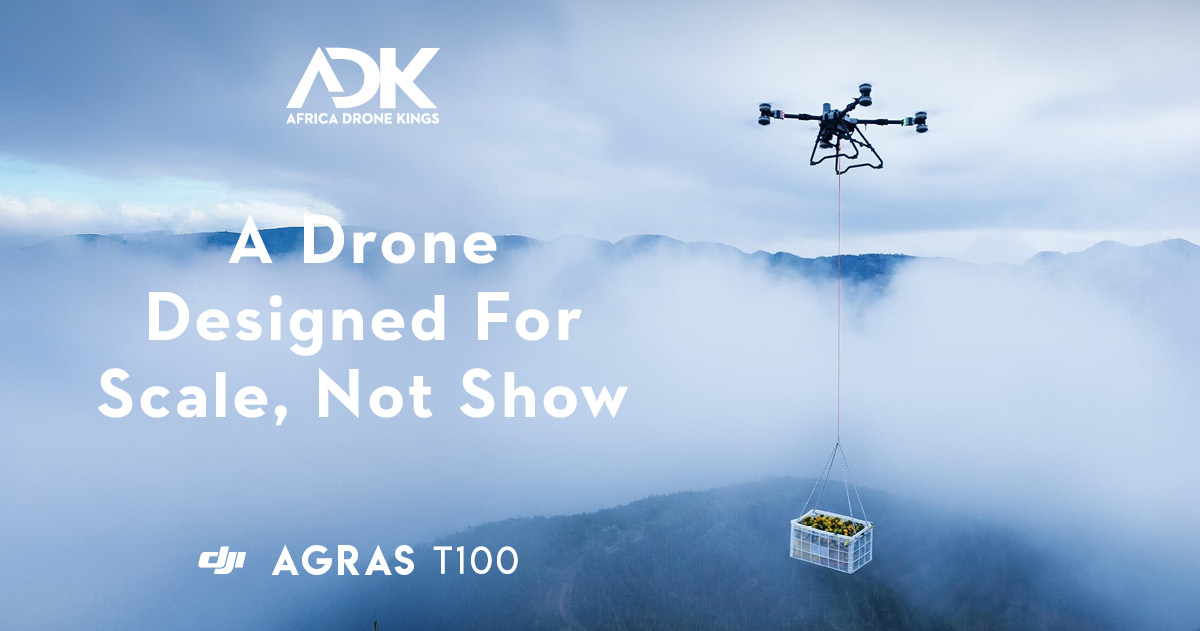
A Drone Designed for Scale, Not Show
One of the biggest misconceptions around agricultural drones is that they’re only useful on small plots or niche applications. In reality, South African farms often span thousands of hectares, with terrain, wind conditions, and temperatures that quickly expose under-engineered equipment.
The DJI Agras T100 is built specifically for this level of operation.
With a maximum payload capacity of up to 100 kg, the T100 supports multiple application scenarios in a single platform, including:
- High-volume spraying
- Granular spreading
- Heavy-lift agricultural tasks
Its modular design allows the drone to switch between spraying, spreading, and lifting operations, making it far more than a single-purpose machine. This flexibility is particularly valuable in South Africa, where seasonal shifts, crop rotation, and mixed farming operations are common.

Precision Spraying and Spreading Where It Matters Most
At the heart of the T100’s value is precision.
In a country where water scarcity and input costs are constant concerns, blanket application methods are no longer sustainable. The T100 allows farmers to move toward targeted application, reducing waste while improving results.
For spraying operations, the T100 delivers:
- High flow rates for efficient coverage
- Adjustable droplet sizes to suit different crops and conditions
- Consistent application even in challenging wind environments
For spreading, it supports:
- Large-volume granular distribution
- Even broadcasting across wide swaths
- Accurate placement of fertiliser or seed
This aligns directly with the shift toward precision agriculture, highlighted by Farmers Weekly, where drones are increasingly used to apply inputs only where they’re needed, instead of across entire fields. The result is less chemical runoff, lower input costs, and healthier crops.
This precision is enabled by serious hardware.
The T100 is equipped with a 100-litre spray tank and dual atomising centrifugal sprinklers, enabling faster flight speeds, wider spray coverage, and higher operational efficiency across large-scale field applications.
For orchard and high-canopy environments, DJI has gone a step further. The drone uses magnetic drive impeller pumps that are corrosion-resistant and feature an increased chamber volume, allowing the system to meet the high flow demands typical of orchard spraying.
A rear four-sprinkler array maintains uniform coverage from multiple angles, ensuring effective penetration into dense canopies. This is supported by a dual-channel electromagnetic flow meter, which enables real-time flow detection and monitoring so operators can maintain accurate application rates throughout each mission.
In practice, this means more consistent coverage, fewer re-flights, and better outcomes in complex crop environments.

Spreading at Scale – Built for More Than One Crop
Beyond spraying, the DJI Agras T100 sets itself apart through its advanced spreading system, designed to handle a wide range of materials and application scenarios at commercial scale.
The T100 supports four feeder types, allowing operators to configure the drone precisely for the task at hand:
- Extra-large feeder for high-volume agricultural spreading
- Large feeder (optional add-on) for extended capacity
- Medium feeder for balanced, everyday operations
- Small feeder (optional) for finer, more controlled applications
This flexibility makes the T100 suitable not only for fertiliser and seed spreading in row crops and orchards, but also for specialised applications such as aquaculture, where accurate feed distribution and waste reduction are critical.
At the core of this system is a high-precision weighing sensor, which continuously measures payload weight in real time. This enables precise application rates, minimises material waste, and ensures consistent results across large areas. A centrifugal spreader disc further ensures uniform distribution, even at higher flight speeds.
For South African producers facing rising input costs, this level of control directly translates into measurable savings and improved efficiency.

From Fields to Orchards: Built for Complex Terrain
South African agriculture is rarely uniform.
Orchards, vineyards, and uneven terrain introduce challenges that traditional machinery struggles to address. Tight rows, variable canopy heights, and limited access points make ground-based spraying inefficient and often damaging to crops.
The DJI Agras T100 excels in these environments.
Its advanced flight control and sensing systems allow it to operate safely and accurately in:
- Orchards and vineyards
- Undulating terrain
- Fields with obstacles or irregular boundaries
By approaching crops from above, the T100 reduces soil compaction, avoids crop damage, and ensures even coverage where tractors and boom sprayers fall short.

Industry-Leading Safety for Real-World Operations
Safety isn’t a nice-to-have in South African agriculture. It’s essential.
The DJI Agras T100 features industry-leading safety systems, combining:
- Advanced obstacle sensing
- LiDAR and radar-based detection
- Intelligent terrain following
- Redundant systems for stable operation
This level of situational awareness allows the drone to operate confidently around trees, power lines, uneven terrain, and farm infrastructure.
For operators, this means greater confidence, fewer operational interruptions, and safer deployment even in complex environments.

Beyond Spraying: Expanding the Role of the Agricultural Drone
One of the most compelling aspects of the Agricultural Drones such as DJI Mavic 3 Multispectral is how far its capabilities extend beyond spraying and spreading.
Irrigation Planning and Monitoring
Using drone-captured data, farmers can identify water stress patterns across large areas, helping them optimise irrigation schedules and detect leaks or inefficiencies early.
Dam and Infrastructure Inspection
Farm dams, channels, and irrigation infrastructure are often remote and difficult to inspect regularly. A heavy-lift, long-endurance drone like the T100 can support visual inspections without sending staff into unsafe or inaccessible areas.
Security and Perimeter Patrol
As highlighted by Farmers Weekly, drones are increasingly used for farm security in South Africa. While the T100 is first and foremost an agricultural workhorse. You have Drone solutions such as DJI Dock 3 & DJI Matrice 4TD with the ability to cover large areas quickly makes it a valuable asset for:
- Perimeter monitoring
- Fence inspections
- Rapid response to incidents
In a country where farm security is an ongoing concern, this added capability increases the drone’s overall value.

Designed for Heat, Wind and Long Days
South African farms don’t operate in lab conditions.
High temperatures, strong winds, and long operating days are the norm – and equipment needs to perform reliably under that pressure.
The DJI Agras T100 is engineered specifically for these realities. Its robust airframe, powerful propulsion system, and intelligent flight controls allow it to operate consistently in environments where lighter drones struggle. For contractors and producers working within narrow spraying or planting windows, that reliability is critical.
At the core of this performance is a coaxial dual-rotor design paired with carbon fibre propellers, delivering exceptional lift efficiency and flight stability. This configuration generates high thrust while maintaining energy efficiency, even under heavy payloads and elevated temperatures.
Carbon fibre propellers add strength without unnecessary weight, improving responsiveness and durability in windy conditions. Together, these design choices ensure the T100 remains powerful, efficient, and dependable throughout long operating days in the heat and wind that define much of South African agriculture.

Understanding the Real Return on Investment
For many farmers, the upfront cost of a large agricultural drone raises valid questions. But the DJI Agras T100 isn’t an expense — it’s an operational shift.
Over time, the savings become clear:
- Reduced labour costs
- Lower fuel usage compared to ground machinery
- More efficient water and chemical application
- Faster turnaround during critical periods
When viewed across multiple seasons, the T100 helps offset its initial cost through operational efficiency, improved yields, and reduced waste. This long-term perspective is increasingly important as margins tighten and sustainability becomes a business necessity.
Why the DJI Agras T100 Matters in South Africa
South African agriculture demands tools that are built for reality, not marketing brochures.
The DJI Agras T100 answers that demand with:
- Scale that matches commercial farming
- Flexibility across spraying, spreading, and lifting
- Safety systems designed for complex environments
- Performance that holds up in heat, wind, and distance
- A platform that supports precision, sustainability, and long-term ROI
That’s why the DJI Agras T100 is rapidly becoming one of the most searched-for agricultural drones in the country. It’s not just about flying. It’s about farming smarter, safer, and more sustainably from above.